01
She hesitates instead of making the play.
She passes up an open shot, stops attacking, or starts thinking instead of reacting.
If she looks confident in practice but starts hesitating, overthinking, or carrying mistakes with her in games, more reps may not be the answer. Her mental game can be trained too.
She has already put in the physical work. That is what makes it so frustrating when the player you see in practice seems to disappear when the game gets hard.
She passes up an open shot, stops attacking, or starts thinking instead of reacting.
The possession is over, but mentally she is still replaying it and trying not to make another mistake.
Playing time, coaches, parents, the scoreboard, recruiting, and expectations can change how freely she competes.
Encouragement matters, but reassurance is different from having mental-performance skills she has practiced.
When she misses two shots, turns the ball over, thinks her coach is frustrated, or knows people are watching, telling her to relax does not tell her what to do next.
You don’t have to become a different player. You need to learn how to trust the player you’ve already trained to become.
That is what mental performance training is for.Begin with a personalized Mental Game Audit, or explore six months of private mental performance coaching and mentorship.
You can see something is getting in her way, but you are not sure what. Start by getting a clearer picture of her mental game and what to work on first.
For competitive female basketball players from middle school through college who want to bring more of their practice game into competition and develop mental skills that hold up across a season.
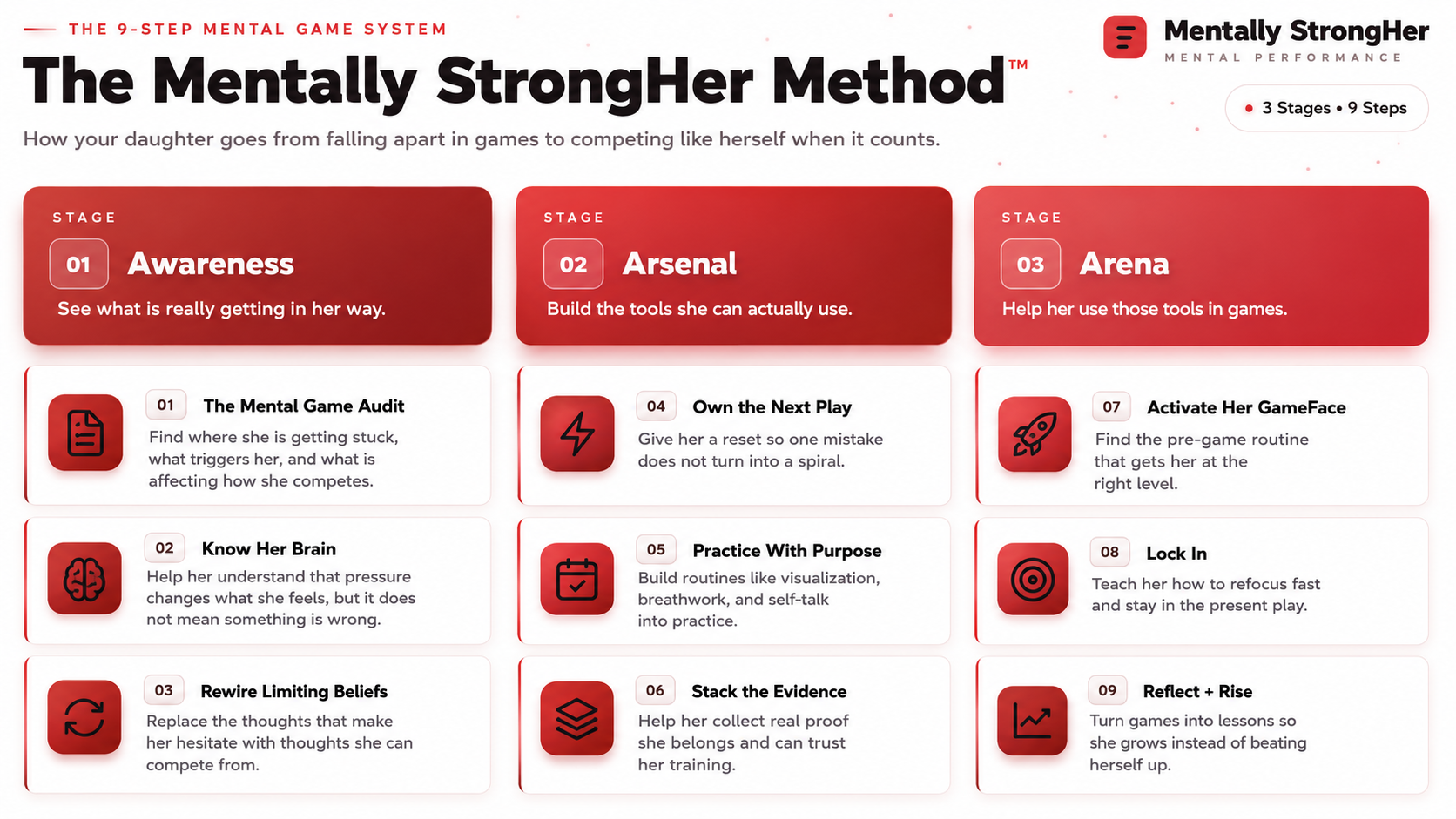
The Mentally StrongHer™ Method helps female basketball players understand what is happening in their mental game, develop the right tools, and learn how to use those tools when the pressure is actually on.
I won two national championships at Stanford, became a two-time All-American, and played professionally. And I still reached moments when I could not access the player I knew I was.
I had coaches for shooting, strength, conditioning, and basketball. What I did not have was a process for pressure, doubt, mistakes, and everything happening mentally while I competed.
Today I combine what I lived as an athlete with formal training in sport and performance psychology to help female basketball players train that part of their game earlier.
Start with the Mental Game Audit and get a personalized picture of her mental game plus a 90-day plan for what to work on next.
Start Her Mental Game Audit →